
Quick Summary
Street lights typically turn on automatically at dusk and off at dawn, controlled by photocells or timers. The exact time varies daily with sunrise and sunset, influenced by season and location. Understanding this system helps with home lighting and safety planning.
Ever found yourself wondering, “What time do street lights come on?” It’s a common question, especially when you’re planning outdoor activities, setting up your own landscape lighting, or just curious about how things work in your neighborhood. You might notice them flicking on as the sky darkens, but the exact moment can seem a bit mysterious. This can be frustrating if you rely on that ambient light for safety or ambiance. But don’t worry! We’re going to break down exactly what makes street lights turn on and off, making it simple and clear for you. By the end of this guide, you’ll be an expert on street light timing and understand how you can even use this knowledge for your own home projects.
The Magic Behind Street Light Activation: Dusk and Dawn
The primary factor determining when street lights come on is the amount of natural light available. They aren’t on a strict clock schedule like your alarm clock; instead, they’re designed to react to the changing light conditions throughout the day. This ensures they only operate when needed, saving energy and providing illumination precisely when visibility decreases.
Think of it like your own eyes adjusting to the light. As the sun begins to set, the sky gets darker, and our eyes need more light to see clearly. Street lights do the same, but they have a built-in sensor to tell them when it’s “time.” Similarly, as the sun rises, the natural light increases, and the street lights switch off, returning to their daytime rest.
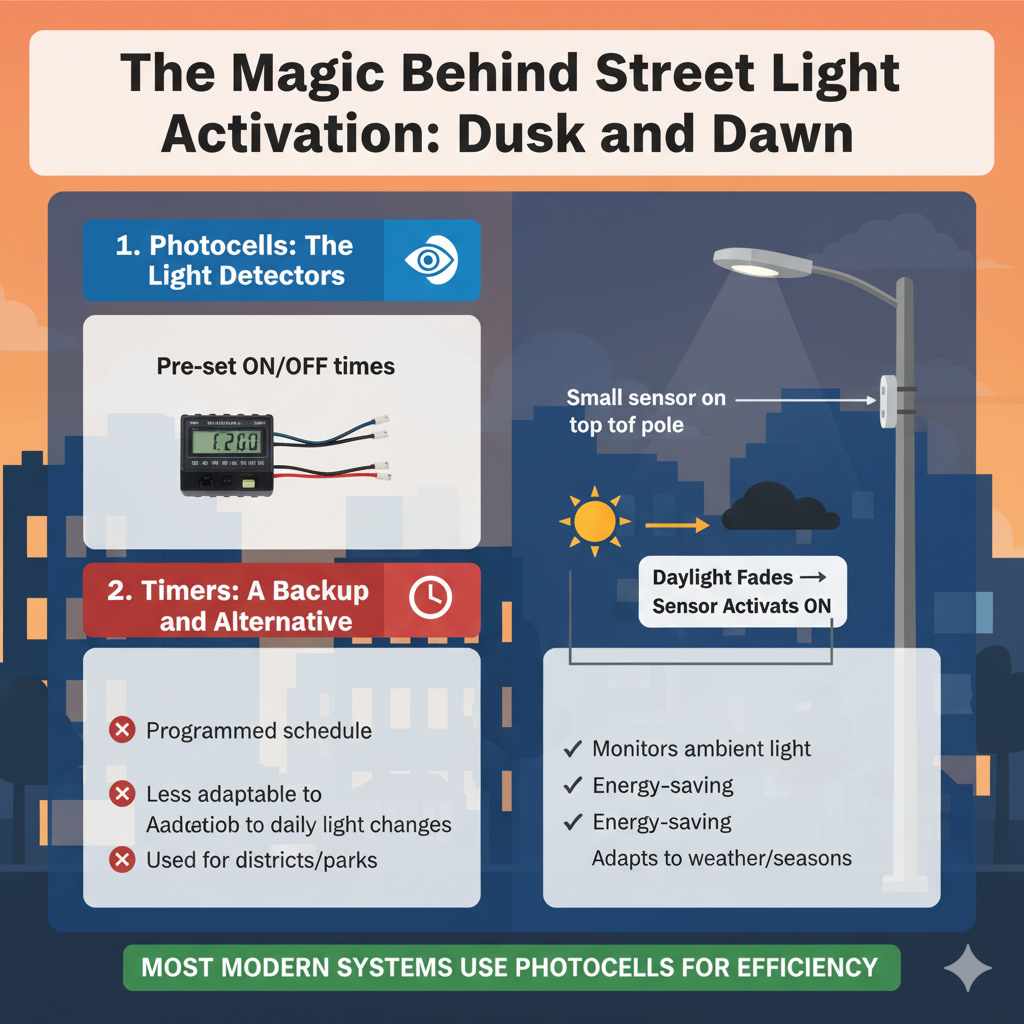
Photocells: The Light Detectors
The most common technology used to control street lights is a device called a photocell, also known as a photosensor or dusk-to-dawn sensor. This small, disc-shaped component is usually visible on top of the street light fixture.
A photocell works by detecting the ambient light levels. It contains a light-dependent resistor (LDR) or a similar light-sensitive element. When there’s enough natural light, the resistance in the photocell is high, preventing electricity from flowing to the light. As daylight fades and the light intensity drops below a certain threshold, the resistance decreases, allowing electricity to flow and the street light to turn on.
- How it Works: The photocell constantly monitors the surrounding light.
- Sensitivity: They are calibrated to react to specific levels of darkness.
- Placement: Usually mounted on top of the light pole for unobstructed sky view.
- Benefit: Ensures lights are on only when it’s dark, saving energy.
These photocells are incredibly reliable and are the backbone of modern street lighting systems. They adapt automatically to the changing seasons and weather conditions, meaning you don’t have to manually adjust anything. This is a huge advantage, as it means the lights are always working for you without any intervention.
Timers: A Backup and Alternative
While photocells are the most prevalent method, some older or specific street lighting systems might use timers. These are mechanical or digital devices set to turn lights on and off at predetermined times.
Timers are less common for individual street lights but might be used for larger municipal lighting systems or specific areas where consistent on/off times are crucial, regardless of minor light fluctuations. For instance, a park might have lights on a timer to ensure they’re off by a certain hour to conserve energy, even if it’s still a bit dim.
- Types: Mechanical timers (older) or digital timers (modern).
- Setting: Programmed with specific on/off times.
- Use Cases: Can be used for entire districts or specific facilities.
- Limitation: Don’t adapt to daily changes in sunset/sunrise times as well as photocells.
In many modern systems, a combination of photocells and timers might be used. For example, a timer could set a general window, and the photocell fine-tunes the exact moment within that window. This provides an extra layer of control and energy efficiency.
Factors Influencing Street Light On-Time
While the core mechanism is light detection, several factors can influence the exact time your street lights illuminate your surroundings. It’s not just a simple “dark equals on.”
1. Season and Daylight Hours
This is the biggest variable. The time of sunset and sunrise changes dramatically throughout the year. This means the time street lights come on and go off will also shift.
- Summer: Days are longer, so street lights will turn on later in the evening and turn off later in the morning.
- Winter: Days are shorter, meaning street lights will activate earlier in the evening and switch off earlier as dawn approaches.
- Spring and Autumn: These are transitional seasons where the on/off times gradually shift each day.
To get a precise idea, you can always check local sunrise and sunset times for your area. For example, in mid-December in New York City, sunset might be around 4:30 PM, meaning street lights could be on by then. In mid-June, sunset might be closer to 8:30 PM, and the lights would stay off until then.
2. Geographic Location
Where you are on the planet significantly impacts daylight hours. Someone living in Alaska will have vastly different street light schedules compared to someone living near the equator.
- Latitude: Higher latitudes experience more extreme variations in daylight throughout the year.
- Longitude: Affects the precise timing of sunrise and sunset within a time zone.
Street light systems are typically calibrated for the specific latitude and longitude of the area they serve. This ensures they function optimally for local conditions. Municipalities work with lighting engineers to ensure the systems are set up correctly for their region.
3. Weather Conditions
Cloudy days, fog, or heavy rain can trick photocells into thinking it’s darker than it actually is. This can cause street lights to turn on earlier in the afternoon.
- Heavy Cloud Cover: Significantly reduces ambient light, potentially triggering lights prematurely.
- Fog/Smog: Similar to clouds, these can obscure sunlight and cause lights to activate sooner.
- Rainstorms: Especially during the day, can create dark conditions that activate the lights.
This is a common observation. You might notice the street lights are on during a very dark, stormy afternoon. This is the photocell doing its job, ensuring safety and visibility even when natural light is poor.
4. Local Regulations and Energy Saving Programs
While photocells are automatic, local authorities might implement specific programs or regulations. These could include dimming schedules during certain hours of the night or turning off lights in less-trafficked areas to save energy.
- Dimming: Lights may be programmed to dim after midnight when traffic is minimal.
- Specific Zones: Lights in certain areas might have different schedules than those in main thoroughfares.
- Energy Initiatives: Municipalities may adjust settings to meet energy conservation goals.
These are less about the physical “on” time and more about how the lights operate once they are on. It’s all part of a larger effort to manage energy consumption efficiently.
How to Estimate When Your Street Lights Will Come On
Since street lights are primarily controlled by light levels, you can get a good estimate by observing the sky and knowing your local sunset times. Here’s a simple approach:
1. Check Local Sunset Times
The easiest way to get an idea is to look up the sunset time for your specific location. Many weather apps, websites, and even simple Google searches can provide this information for any day of the year.
For example, you can search “sunset time [your city, your state].” This will give you a precise time. Street lights will typically begin to activate in the 15-30 minutes leading up to and around this sunset time, depending on how quickly the sky darkens.
You can find reliable sunrise and sunset data from sources like the U.S. Naval Observatory, which provides astronomical data for locations worldwide. Check out their Sunrise/Sunset data page for accurate calculations.
2. Observe Your Surroundings
Pay attention to the light outside. As the sun dips below the horizon, the sky will start to change color, and visibility will decrease. The street lights will begin to flicker on as the ambient light reaches the photocell’s trigger point.
This is often a gradual process. You might see one or two lights come on at first, followed by others as the sky continues to darken. This organic activation is a testament to the photocell technology at work.
3. Consider the Season and Weather
As we discussed, the season is a major factor. If it’s winter, expect them on much earlier than in summer. On a heavily overcast day, they might appear sooner than the official sunset time suggests.
A good rule of thumb is to think about when you personally start needing to turn on your indoor lights. Street lights will often follow a similar pattern, though their sensors are set to a specific, standardized level of darkness.
Street Light Technology: A Closer Look
The technology behind street lights has evolved significantly over the years. Understanding these advancements can provide further insight into their operation.
Traditional High-Intensity Discharge (HID) Lamps
Historically, street lights used High-Intensity Discharge (HID) lamps, such as mercury vapor, metal halide, or high-pressure sodium lamps. These lamps are energy-intensive and have a warm-up period.
- High-Pressure Sodium (HPS): Known for their distinctive orange-yellow glow. They are durable and efficient for their time.
- Metal Halide: Produce a whiter, brighter light, often used in areas where color rendering is important.
- Warm-up Time: These lamps take several minutes to reach full brightness after being switched on. This is why they don’t typically turn on and off instantly like newer technologies.
The photocell or timer would activate these lamps, and they would then need time to “warm up” to their full illumination. This is why you might have seen them slowly brighten rather than instantly switch on.
The Rise of LED Street Lighting
Modern street lighting is increasingly transitioning to Light Emitting Diode (LED) technology. LEDs offer numerous advantages, including energy efficiency, longer lifespan, and better light quality.
LEDs also have a significant advantage regarding their activation:
- Instant On: LEDs reach full brightness immediately, with no warm-up period.
- Energy Efficiency: They use significantly less energy than traditional HID lamps.
- Longevity: LEDs last much longer, reducing maintenance costs.
- Controllability: They can be easily dimmed or controlled remotely, allowing for smart city applications.
This means that LED street lights, when controlled by photocells, will turn on and off much more responsively to light changes. The transition from day to night feels more immediate with LED systems.
Smart Lighting Systems
The most advanced street lights are part of “smart” lighting networks. These systems go beyond simple on/off control.
Smart street lights can:
- Be Remotely Controlled: Operators can adjust brightness, turn lights on/off, or schedule them from a central location.
- Report Malfunctions: The lights can self-diagnose issues and report them to maintenance crews.
- Integrate with Sensors: Some smart lights can incorporate sensors for traffic, air quality, or noise.
- Adapt to Traffic: Brightness can adjust based on real-time traffic flow.
These systems offer unparalleled efficiency and operational flexibility. For these lights, the “on time” might be less about a photocell and more about a command from a central server, though photocells are often still included as a fail-safe.
What Time Do Street Lights Come On: A Practical Comparison
To give you a clearer picture, let’s compare estimated on-times based on general conditions. Remember, these are approximations and will vary by location and specific equipment.
| Season | General Time of Sunset (Approx.) | Estimated Street Light On-Time (Approx.) | Notes |
|---|---|---|---|
| Winter (e.g., December) | 4:30 PM – 5:00 PM | 4:15 PM – 5:15 PM | Lights come on relatively early. Can be earlier on very cloudy days. |
| Spring (e.g., March) | 6:00 PM – 7:30 PM | 5:45 PM – 7:45 PM | Transitioning to later on-times. |
| Summer (e.g., June) | 8:00 PM – 8:30 PM | 7:45 PM – 8:45 PM | Lights come on latest in the evening. |
| Autumn (e.g., September) | 6:30 PM – 7:30 PM | 6:15 PM – 7:45 PM | Transitioning to earlier on-times. |
This table highlights how significantly the season impacts when street lights are activated. The “Estimated Street Light On-Time” is generally within a window around the official sunset, accounting for the gradual darkening of the sky and the sensitivity of photocells.
Street Light Off-Times
Just as street lights come on at dusk, they turn off at dawn. The same principles apply: photocells detect increasing ambient light, or timers initiate the switch-off sequence.
The off-times will also vary with the seasons and weather. In winter, they might be off by 6:00 AM, while in summer, they could stay on until 5:00 AM or later. The key takeaway is that they are reactive to light, ensuring you have illumination when you need it most during the night and early morning hours.
Your Home Lighting and Street Lights
Understanding how street lights work can actually be quite useful for your own home improvement projects, especially when it comes to outdoor lighting.
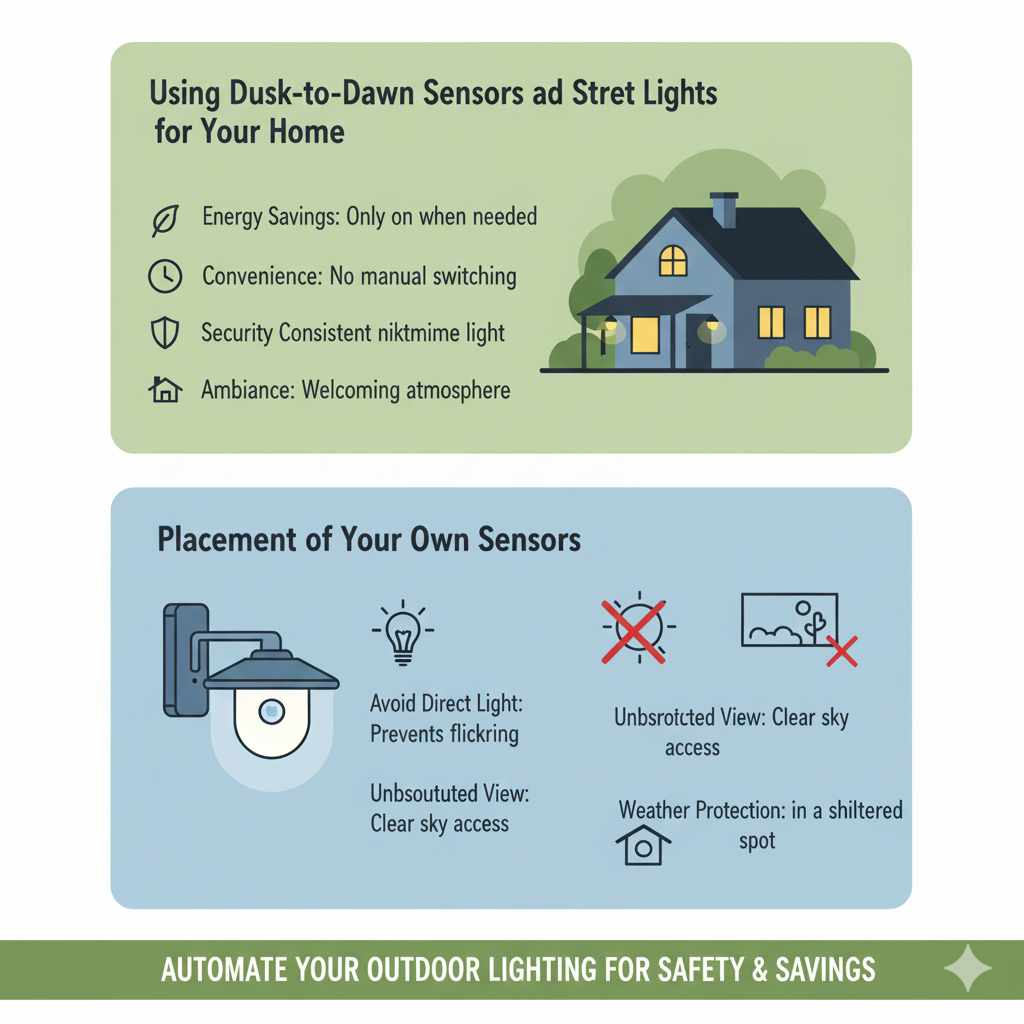
Using Dusk-to-Dawn Sensors for Your Home
You can purchase and install dusk-to-dawn sensors for your own outdoor lights, such as porch lights, landscape lighting, or security lights. These work on the same principle as street light photocells.
Benefits of Home Dusk-to-Dawn Sensors:
- Energy Savings: Lights are only on when needed, reducing electricity bills.
- Convenience: No need to remember to turn lights on or off manually.
- Security: Provides consistent lighting after dark for safety and deterring intruders.
- Ambiance: Can create a welcoming atmosphere around your home.
When selecting a sensor, ensure it’s compatible with your existing light fixtures and bulbs. Installation is usually straightforward, often involving wiring the sensor into the circuit. For detailed installation guidance, consulting the manufacturer’s instructions or a qualified electrician is always recommended, especially if you’re not comfortable with electrical work.
For DIYers, many outdoor fixtures come with integrated dusk-to-dawn sensors, making the process even simpler. You might also find smart bulbs that can be programmed with an app to mimic dusk-to-dawn functionality.
Placement of Your Own Sensors
Just like with street lights, the placement of your home’s dusk-to-dawn sensor is crucial. It needs a clear view of the sky to accurately detect light levels.
- Avoid Direct Light: Don’t point the sensor directly at a light fixture, as this can cause the light to turn off immediately after it turns on, creating a “flicker” effect.
- Unobstructed View: Ensure there are no trees, eaves, or other obstructions blocking its view of the sky.
- Weather Protection: While most sensors are weather-resistant, ensure they are mounted in a location that offers some protection from direct rain and extreme conditions if possible.
Proper placement ensures your home lighting system operates reliably and efficiently, just like the municipal street lights you see every day.
Frequently Asked Questions (FAQ)
Q1: Do street lights turn on at a specific time every day?
A1: No, street lights don’t typically turn on at a specific, fixed time. They are usually controlled by photocells that detect ambient light levels, meaning they turn on as it gets dark (dusk) and off as it gets light (dawn). This timing varies daily with sunrise and sunset.
Q2: Why do street lights sometimes come on during the day?
A2: This usually happens on very dark, overcast days, during heavy rain or fog, or if a photocell is malfunctioning. The sensor interprets the low light conditions as nighttime and activates the lights for safety.
Q3: How can I find out the exact time street lights come on in my area?
A3: You can estimate by checking the local sunset times for your city. Street lights generally come on in the 15-30 minutes leading up to and around sunset. Observing your local lights at dusk is the most direct way to know.
Q4: Are all street lights controlled by photocells?
A4: Most modern street lights use photocells. However, some older systems or specific installations might use timers set to specific on/off times, or they might be part of advanced smart lighting systems with remote control capabilities.
Q5: Will my street lights turn on if a tree branch falls on them?
A5: If a tree branch obstructs the photocell on top of the light pole, it can prevent the light from turning on. In some cases, if the branch is heavy enough to damage the fixture or wiring, it could also cause the light to malfunction or stay off.
Q6: Can I install a dusk-to-dawn sensor on my existing porch light?
A6: Yes, in most cases, you can. You can buy separate dusk-to-dawn sensors that wire into your existing fixture, or you can find light bulbs with built-in sensors. Always ensure compatibility and follow electrical safety guidelines or consult a professional.
Q7: Why do street lights sometimes have an orange glow, and others are white?
A7: The color of the light depends on the type of bulb used. Older, high-pressure sodium (HPS) lamps produce the characteristic orange-yellow light, while newer LED or metal halide lamps typically produce a whiter, brighter light. This is a technological difference, not a timing one.
Conclusion
So, what time do street lights come on? The answer, in essence, is: when it gets dark enough. They are intelligent systems, primarily governed by the natural rhythm of day and night through photocells, and secondarily by timers or smart controls. The exact moment shifts daily with the seasons, influenced by your geographic location and even the day’s weather. Understanding these principles not only satisfies your curiosity but also empowers you to enhance your own home’s outdoor lighting with similar, convenient, and energy-saving technologies.
Whether you’re looking to improve your home’s security, add ambiance to your garden, or simply want to reduce your energy bills, incorporating dusk-to-dawn sensors is a fantastic DIY project. Just remember to place them correctly for optimal performance. With a little knowledge and the right tools, you can bring smart lighting solutions to your own doorstep, mirroring the reliable illumination provided by your neighborhood street lights.