
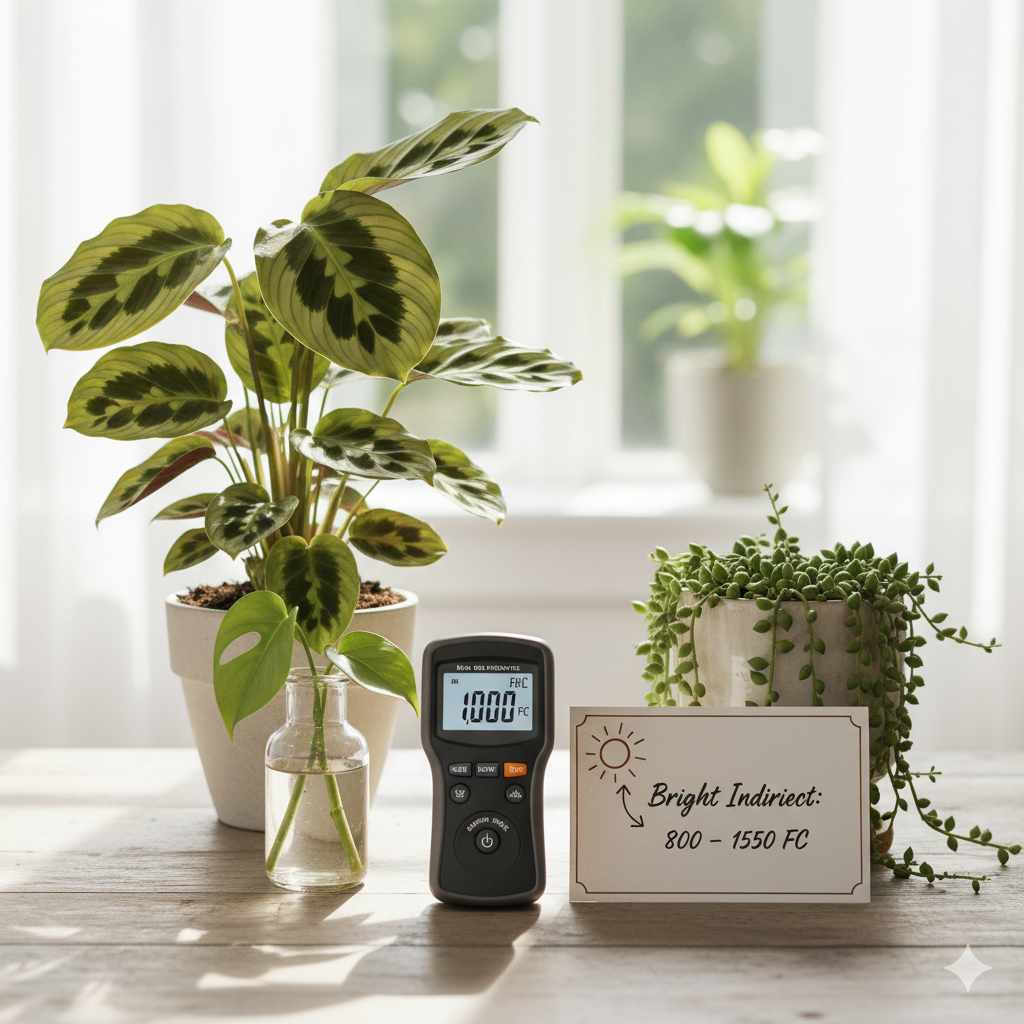
Quick Summary: Bright indirect light typically falls between 200 and 500 foot candles. This level provides enough illumination for many plants to thrive without the harshness of direct sun, and is also a comfortable level for many home tasks.
Ever stood in a room, trying to figure out if your new plant is getting enough light, or if your workspace is just right? It can feel like a guessing game, especially when terms like “bright indirect light” come up. Don’t worry, I’ve been there! Understanding light levels is key, whether you’re setting up a cozy reading nook or nurturing a finicky fiddle-leaf fig. This guide will cut through the confusion and help you measure and achieve the perfect “bright indirect light” using a simple tool you might already have.
We’ll break down what foot candles really mean and how they apply to your home. By the end, you’ll feel confident knowing exactly how much light your plants and projects need. Let’s make your home a little brighter and a lot happier!
What Are Foot Candles, Anyway?
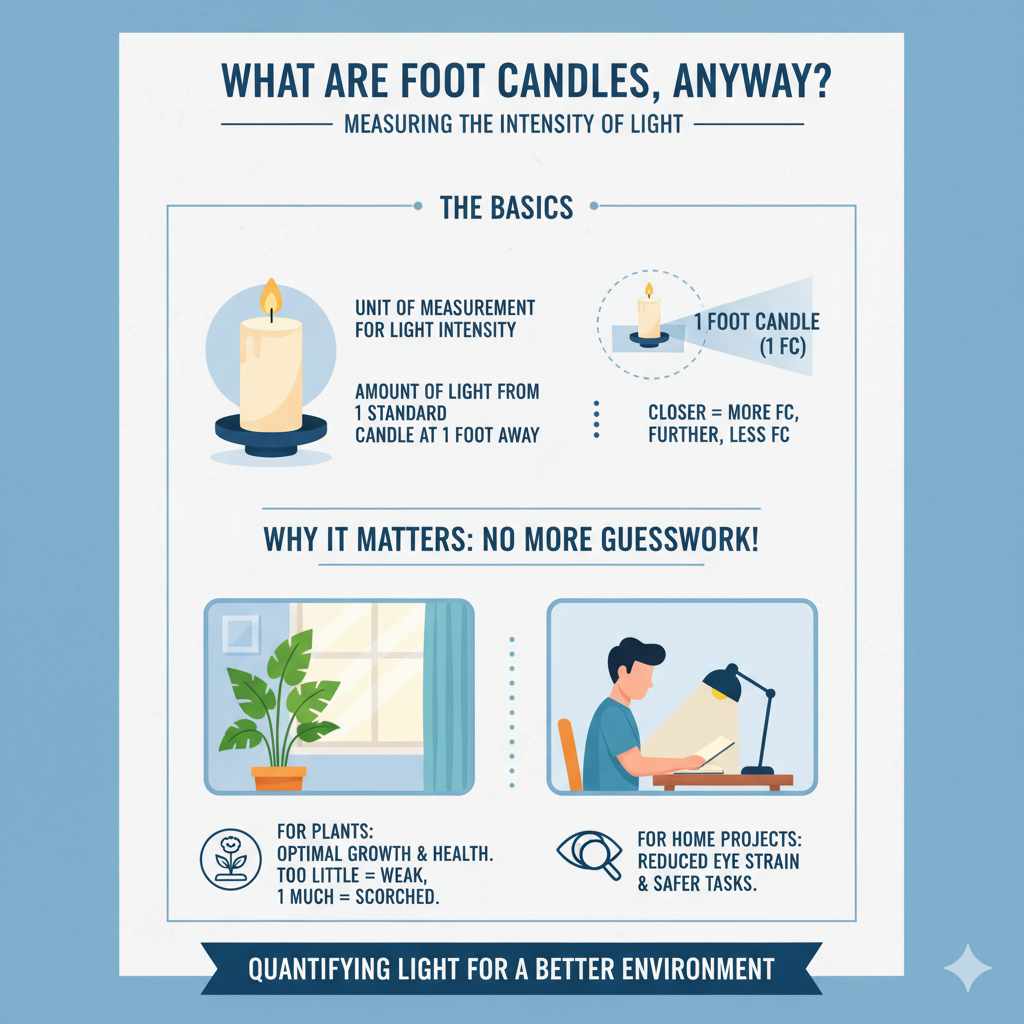
Before we talk about “bright indirect light,” let’s get a handle on what a “foot candle” is. Think of it as a unit of measurement, like inches or pounds, but for light. Specifically, a foot candle measures the intensity of light that falls on a surface. One foot candle is the amount of light cast by one standard candle at a distance of one foot.
It’s a pretty straightforward idea: the closer you are to a light source, the more foot candles you’ll experience. The further away you get, the fewer foot candles. This measurement helps us quantify how bright a space truly is, which is super useful for everything from setting up your workshop to deciding where to place your beloved houseplants.
Why Measuring Light Matters
Why bother with numbers when we can just say “bright” or “dim”? Well, our eyes can be a bit subjective. What seems bright to me might be just okay for you, and what looks like a good spot for a plant might actually be too intense or too shady. Using a standard measurement like foot candles takes the guesswork out of it.
For plants, getting the right amount of light is crucial for their health and growth. Too little light, and they get leggy and weak. Too much direct light, and their leaves can scorch. For our home projects, like woodworking or reading, proper lighting reduces eye strain and makes tasks safer and more enjoyable. It’s all about creating the right environment for what you’re doing.
The Magic Number: How Many Foot Candles for Bright Indirect Light?
Now for the big question: how many foot candles does “bright indirect light” actually represent? For most common scenarios, especially when we’re talking about houseplants or comfortable home lighting, bright indirect light generally falls within the range of 200 to 500 foot candles.
This range is a sweet spot. It’s bright enough to be useful and stimulating, but not so harsh that it causes problems. Think of a room with a large window that gets a lot of daylight, but the sun isn’t directly hitting the spot where you’re measuring. That’s often where you’ll find this ideal light level.
Understanding the Range
It’s important to remember that 200-500 foot candles is a range, not a single, fixed number. Different plants have slightly different needs, and personal preferences for lighting can vary.
- Lower end (200-300 foot candles): This is still quite bright, but on the gentler side of indirect light. Many plants that prefer “medium to bright indirect light” will do well here. It’s also a pleasant level for general ambient lighting in a living room or bedroom.
- Mid-range (300-400 foot candles): This is the heart of bright indirect light. It’s ample illumination for a wide variety of houseplants that crave good light but are sensitive to direct sun. It’s also excellent for tasks like crafting or detailed work that doesn’t require the intense focus of task lighting.
- Upper end (400-500 foot candles): Pushing towards the higher end of indirect light. Some plants that are often labeled as needing “bright light” will thrive here. This level can also be great for areas where you need good visibility, like a kitchen counter or a home office desk, provided there’s no glare.
Anything significantly above 500 foot candles might start to feel like direct sun to a sensitive plant, and might be too intense for comfortable, prolonged tasks without a bit of adjustment. Conversely, below 200 foot candles, you’re likely moving into medium or low light territory.
How to Measure Foot Candles: Your Essential Guide
So, how do you actually measure this? You don’t need a fancy, expensive setup. The easiest and most accessible way for most homeowners is to use a smartphone app or a dedicated light meter. Many modern smartphones have light sensors that can be utilized by apps to give you a reading in foot candles.
Using a Smartphone App
There are numerous apps available for both iOS and Android that can measure light levels. Search your app store for “light meter” or “lux meter” (lux is another unit of illuminance, where 10.76 lux equals 1 foot candle). Many of these apps are free or very inexpensive.
Steps to measure with your phone:
- Download an app: Find a well-rated light meter app in your phone’s app store.
- Calibrate (if prompted): Some apps might ask you to calibrate the sensor. Follow the instructions carefully.
- Position your phone: Hold your phone at the height where you want to measure the light. For plants, this is usually at the soil level or where the leaves are. For workspaces, it’s at desk height.
- Point the sensor: The light sensor on most phones is usually near the front-facing camera. Make sure this area isn’t covered and is facing the general direction of the light source (but not directly at the sun if you’re trying to measure indirect light!).
- Take the reading: Open the app and it should display a reading in foot candles or lux. If it’s in lux, you can convert it by dividing by 10.76 to get foot candles.
- Move and re-measure: Walk around the area, taking readings at different spots to get a good understanding of the light distribution.
Important Note: Smartphone light meters are generally good for getting a ballpark figure. For highly precise measurements, especially in professional settings, a dedicated digital light meter is recommended. However, for home use, a phone app is usually sufficient to tell you if you’re in the right ballpark for bright indirect light.
Using a Dedicated Light Meter
If you’re really into optimizing your plant care or home lighting, or if you do a lot of DIY projects that benefit from precise lighting, a dedicated digital light meter is a worthwhile investment. These devices are designed specifically for measuring light intensity and are generally more accurate than phone apps.
How to use a dedicated light meter:
- Purchase a meter: You can find these online from various retailers. Look for one that can measure in foot candles (fc) or lux (lx).
- Turn it on and select units: Power on the device and ensure it’s set to measure in foot candles.
- Place the sensor: The sensor is usually a small, flat disc or dome on the meter. Place this sensor at the point where you want to measure the light intensity.
- Hold steady: For a stable reading, hold the sensor still for a few seconds.
- Record the reading: The display will show the foot candle measurement.
- Take multiple readings: As with the phone app, move the meter around the area to understand the light variations.
Dedicated light meters often come with a probe or a remote sensor, allowing you to measure light at different angles and locations more easily.
Where to Find Bright Indirect Light in Your Home
Now that you know how to measure it, where do you typically find this 200-500 foot candle range in a home environment?
Window Placement is Key
The type and placement of your windows are the biggest factors. Generally:
- North-facing windows: These windows receive consistent, soft light throughout the day. They are excellent sources of bright indirect light, especially during the morning and late afternoon.
- East-facing windows: These get direct morning sun, which is less intense than afternoon sun. In the late morning and afternoon, the light from an east-facing window can be beautiful bright indirect light.
- West-facing windows: These receive intense, direct afternoon sun. While they can offer bright indirect light in the morning, the afternoon can be too harsh for many plants or tasks unless there’s significant obstruction.
- South-facing windows: These get the most direct sunlight throughout the day. To get bright indirect light from a south-facing window, you’ll need to place your plants or workspace a few feet away from the window, or use sheer curtains or blinds to diffuse the light.
Distance from the Light Source
The distance from the window matters significantly. Light intensity decreases rapidly with distance.
- Right by the window: If the sun’s rays are directly hitting this spot, it’s direct light. If it’s a window that gets bright light but not direct sunbeams (like a north-facing window), it might be in the higher end of bright indirect.
- A few feet away (2-5 feet): This is often the sweet spot for bright indirect light, especially from east, west, or south-facing windows that are partially obstructed or where the sun has moved past its peak intensity.
- Further back in the room: Light levels drop considerably. You’ll likely be in medium or low light territory here.
Obstructions and Diffusers
Anything that blocks or scatters the light can help create indirect light.
- Sheer curtains or blinds: These are fantastic for diffusing direct sunlight, turning it into bright indirect light.
- Trees or buildings outside: These can cast shade on your windows, providing natural diffusion.
- Overhanging objects: A balcony, awning, or even a strategically placed tall piece of furniture can cast shade.
Bright Indirect Light vs. Other Light Levels
To truly understand bright indirect light, it helps to compare it to other common light descriptions.
Direct Light
Direct light is when the sun’s rays hit a surface without any diffusion. This can be very intense, often exceeding 1,000 foot candles and sometimes reaching 10,000 or more foot candles at peak intensity.
- Characteristics: Intense, hot, casts sharp shadows.
- Good for: Sun-loving plants like cacti and succulents, tasks requiring very high visibility (but often with glare).
- Bad for: Most houseplants, tasks requiring comfortable, prolonged viewing.
Bright Indirect Light
As we’ve discussed, this is our target range: 200-500 foot candles.
- Characteristics: Luminous, well-lit, but without harsh sunbeams; shadows are soft.
- Good for: Many popular houseplants (e.g., Monstera, Pothos, Philodendron), reading, crafting, general home illumination.
- Bad for: Plants that require intense direct sun or very low light.
Medium Light
Medium light typically falls between 100 and 200 foot candles.
- Characteristics: Noticeably lit, but not overly bright. Shadows are present but not very dark.
- Good for: Plants that prefer less intense light (e.g., some ferns, prayer plants), ambient lighting in areas further from windows.
- Bad for: Sun-loving plants, tasks requiring high detail.
Low Light
Low light is generally considered to be under 100 foot candles, sometimes as low as 10-50 foot candles.
- Characteristics: Dimly lit, shadows are faint or non-existent.
- Good for: Shade-tolerant plants (e.g., Snake Plant, ZZ Plant), areas with minimal natural light.
- Bad for: Most houseplants, any task requiring good visibility.
Here’s a quick comparison table:
| Light Level | Foot Candle Range | Characteristics | Typical Uses/Plants |
|---|---|---|---|
| Direct Light | 500+ (often 1,000 – 10,000+) | Intense, hot, sharp shadows | Cacti, succulents, tasks needing high visibility (can cause glare) |
| Bright Indirect Light | 200 – 500 | Luminous, soft shadows | Most houseplants, reading, crafting |
| Medium Light | 100 – 200 | Noticeably lit, soft shadows | Ferns, prayer plants, ambient room lighting |
| Low Light | 10 – 100 | Dim, faint shadows or no shadows | Snake plants, ZZ plants, areas with minimal light |
Understanding these distinctions helps you make informed decisions for both your greenery and your home improvement projects. For instance, if you’re building a workbench, you might aim for a level of illumination that mimics bright indirect light for comfortable working, perhaps supplemented with task lighting if needed.
Optimizing for Plants: Bright Indirect Light Needs
Many popular houseplants absolutely thrive in bright indirect light. This level mimics the conditions they’d find on a forest floor, dappled by the canopy above, or near a window that gets good light but isn’t exposed to scorching direct sun.
Common Plants That Love Bright Indirect Light
- Monstera Deliciosa (Swiss Cheese Plant): Loves bright, indirect light. Direct sun can scorch its leaves.
- Pothos (Epipremnum aureum): Very adaptable, but does best in bright indirect light. Can tolerate lower light but may grow slower and lose variegation.
- Philodendron (various species): Most philodendrons prefer bright, indirect light.
- Fiddle Leaf Fig (Ficus lyrata): Needs bright, indirect light. Can be sensitive to direct sun and drafts.
- Peace Lily (Spathiphyllum): Prefers medium to bright indirect light. Will droop dramatically if it needs water or if light is too intense.
- ZZ Plant (Zamioculcas zamiifolia): While known for tolerating low light, ZZ plants actually grow best and look their fullest in bright, indirect light.
- Spider Plant (Chlorophytum comosum): Tolerant of various conditions but thrives with bright, indirect light.
Tips for Plant Placement
When placing plants, remember that the light intensity changes throughout the day and year.
- Observe your space: Pay attention to how the light moves across your room. A spot that’s perfect in the morning might be too sunny in the afternoon.
- Use sheer curtains: For windows that get direct sun, sheer curtains are your best friend. They diffuse the light beautifully.
- Consider distance: If a window is too bright, pull the plant a few feet back. If it’s too dim, move it closer.
- Rotate your plants: Turn your plants a quarter turn every week or so to ensure all sides get even light exposure.
For a deeper dive into plant-specific light needs, resources like the Royal Horticultural Society (RHS) offer excellent, science-backed guidance.
Optimizing for Home Projects: Bright Indirect Light Needs
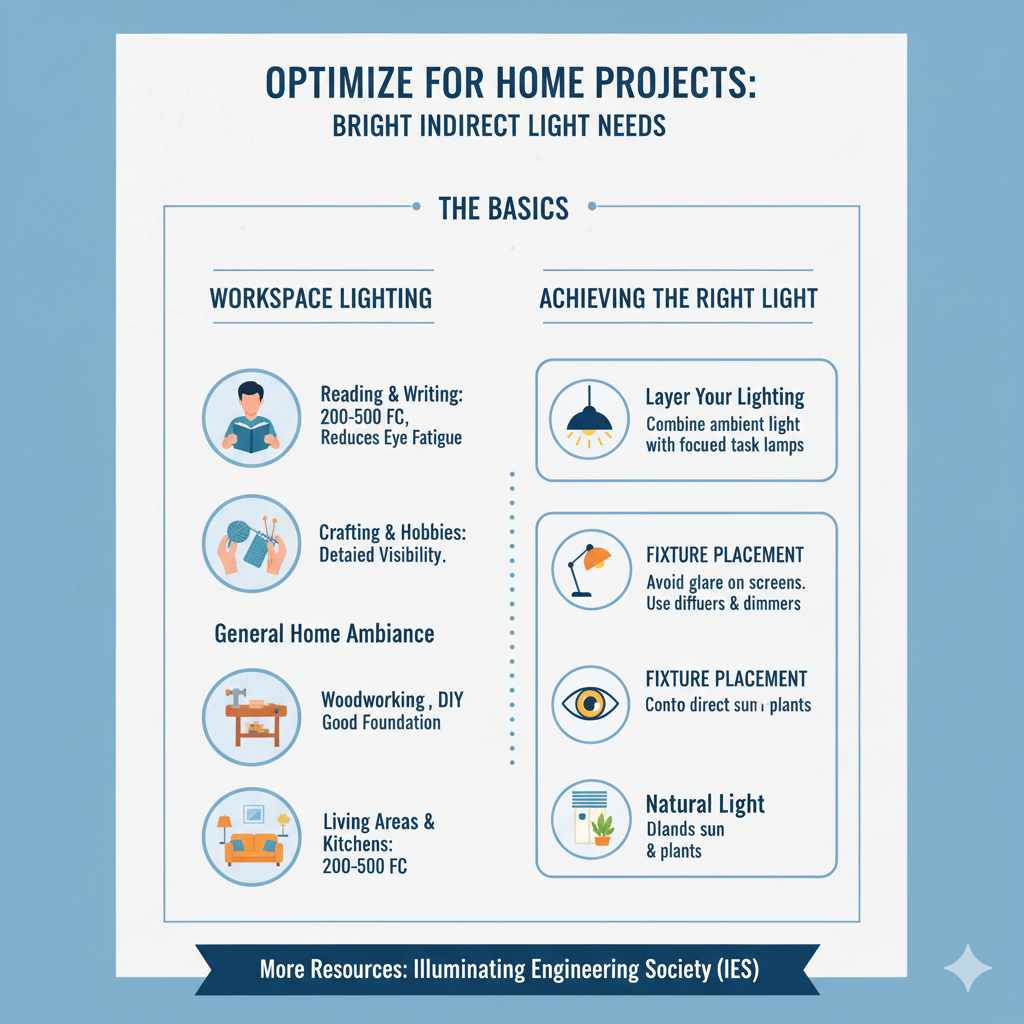
Beyond plants, bright indirect light is a fantastic standard for general home lighting and specific tasks. It provides enough visibility to be functional without causing eye strain or glare.
Workspace Lighting
Whether you’re working at a desk, a workbench, or a craft table, adequate lighting is essential for safety, comfort, and quality of work. Bright indirect light (200-500 foot candles) is a great baseline.
- Reading and Writing: This level is comfortable for extended periods of reading and writing, reducing the risk of headaches and eye fatigue.
- Crafting and Hobbies: For tasks like knitting, drawing, or detailed model building, bright indirect light ensures you can see what you’re doing clearly. You might supplement this with a focused task lamp for very fine detail work.
- Woodworking and DIY: While woodworking often benefits from very bright task lighting directly on the workpiece, the general ambient lighting in your workshop should be comfortable. Bright indirect light can provide a good foundation, preventing you from working in shadows while you move between tasks. For precision cuts or detailed finishing, you’ll want to bring a more intense, focused light source closer.
General Home Ambiance
The 200-500 foot candle range is also ideal for creating a pleasant atmosphere in living areas.
- Living Rooms: Provides enough light for activities like watching TV, conversing, or reading without being harsh.
- Kitchens: While task lighting over counters is crucial (often needing much higher foot candles), the general lighting in a kitchen can be in this bright indirect range for a welcoming feel.
- Hallways and Entryways: Makes these transition spaces feel more inviting and safe to navigate.
Achieving the Right Light Level for Projects
Layer your lighting: The best approach is often to layer different types of lighting. Start with good ambient lighting that falls into the bright indirect range, then add task lighting where specific activities require more focused illumination.
Consider fixture placement: Position lamps and overhead fixtures so they illuminate the area effectively without creating glare on screens or work surfaces. Diffusers, shades, and dimmers are your friends!
Natural light management: Use blinds, shades, or even strategically placed houseplants to control direct sunlight. You want to capture the brightness without the harshness.
For more on home lighting standards, you can check out resources from organizations like the Illuminating Engineering Society (IES), which provides detailed recommendations for various environments.
Frequently Asked Questions (FAQ)
What exactly is a foot candle?
A foot candle is a unit of measurement for illuminance, which is how much light falls on a surface. One foot candle is equal to the light received by a surface that is one foot away from a standard candle.
Is 500 foot candles considered bright indirect light?
Yes, 500 foot candles falls at the higher end of the bright indirect light spectrum. It’s a very well-lit area but typically without the direct, harsh rays of the sun. This level is excellent for many light-loving plants and comfortable for most home tasks.
Can I use my phone to measure foot candles?
Yes, you absolutely can! Many smartphone apps are available that use your phone’s built-in light sensor to measure light levels. Search for “light meter” or “lux meter” in your app store. Remember that lux is more common, and you can convert lux to foot candles by dividing by 10.76.
What is the difference between lux and foot candles?
Both are units of illuminance. Lux is the metric unit, while foot candles are the imperial unit. One foot candle is approximately equal to 10.76 lux. So, if an app gives you a reading in lux, you can easily convert it to foot candles by dividing the lux value by 10.76.
How far from a window is bright indirect light?
This varies greatly depending on the window’s direction and any obstructions. Generally, bright indirect light can be found a few feet (2-5 feet) away from an east, west, or south-facing window, especially if sheer curtains are used or the sun isn’t directly hitting that spot. North-facing windows often provide bright indirect light closer to the glass.
Will direct sunlight from a south window hurt my plant?
Yes, direct sunlight from a south-facing window can be too intense for most common houseplants and can cause leaf scorch, characterized by brown, crispy patches. To get bright indirect light from a south window, you’ll need to diffuse the light with sheer curtains or place the plant several feet away from the window.
Is bright indirect light good for all plants?
No, not all plants thrive in bright indirect light. Some plants, like cacti and succulents, require direct sunlight. Others, like certain ferns or low-light tolerant plants (e.g., Snake Plant, ZZ Plant), prefer medium to low light conditions and can be damaged by too much bright indirect light.
Conclusion
Navigating the world of light levels might seem a bit technical at first, but understanding foot candles and the “bright indirect light” range opens up a whole new level of care for your plants and comfort in your home. Remember, that sweet spot of 200 to 500 foot candles is your go-to for many happy houseplants and functional, pleasant living spaces.
Don’t be afraid to grab your phone and a light meter app to start measuring. It’s a simple step that can make a big difference. Whether you’re a seasoned plant parent or just starting out with DIY projects, knowing how to identify and achieve the right lighting conditions will boost your confidence and lead to better, more beautiful results. Keep experimenting, keep observing, and enjoy creating the perfect environment in your home!